The Japanese building code is a collection of related laws and regulations, rather than a single unified document. In this article we’ll discuss the sources of lawful requirements and their relationship with each other.
In the previous articles we discussed Japan's National Government and Local Governments in Japan and the Law Making in Japan. But there are a few other sources that can create regulations with the force of law. First, let's review the three types of law, categorized by source:
Architects and engineers don’t need to spend a lot of time reading judgements and case law. Judicial law often either becomes formalized as revisions to laws and regulations or is effective as a guiding interpretation of existing laws and conditions.
By and large the overwhelming source of lawful requirements that make up the building code come from the laws (法律) and orders (命令). In Japanese these two concepts combine to make the formal term for law 法令, with the sense of laws and regulations.
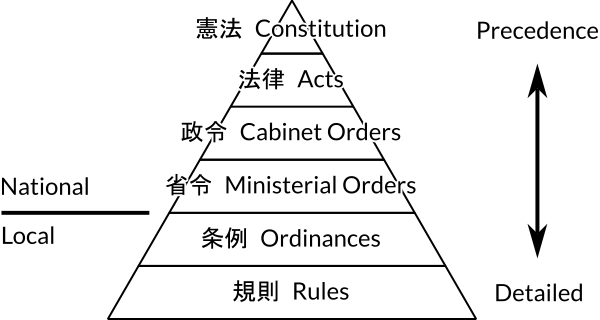
Now, let’s put it all together. What are the sources and their relationship to each other. The following illustration shows the laws and the order of precedence.
There are two important relationships to recognize, building on the knowledge from the previous articles:
Here are some notes regarding each of these levels of the hierarchy:
As the supreme law of the land, it is the foundation for all other laws. There are no specific building code requirements in the Constitution. Rather, this law is the charter for the structure of government, rights of the citizens and foundation of all other laws.
After the Constitution, Acts are laws enacted by the National Diet are the primary laws that impact daily life and business. There are several individual Acts that relate to the building code, for example:
Other articles on this website dig deeper into specific lists of Acts that are related to design and construction in Japan.
Orders are created by the Cabinet and individual Ministers of ministries that are closely related to enacted laws. For this reason, there are two types of orders you should be familiar with:
Cabinet (execution) orders are called 政令, but typically the names of specific execution orders take the name of the related Act and replace 法 with 施行令, lit. “enforcement order.”
A cabinet order is always signed by the Prime Minister and cosigned by the Minister of the Ministry that is responsible to the Diet for administering the related Act.
Cabinet orders are lawful orders that provide additional detailed requirements that are necessary for the execution of the related Act. The ability to implement punishments, fines and fees are restricted to the authority granted by the related Act.
Cabinet orders may defer additional requirements to be determined by Ministerial Orders (省令 ). Like Cabinet Orders, specific ministerial orders usually take the name of the parent Act but replace 法 with 施行規則, lit. “enforcement rules.”
NOTE: the suffix 規則 is used in this context to indicate a Ministerial Order, however, this same term is also used for “rules” issued by Governors or Mayors – these are not the same thing and do not have the same precedence.
Ministerial orders are signed by the Minster of the Ministry that is responsible to the Diet for administering the related Act. Typically, these orders provide further administrative details, beyond what typically would be specified in a Cabinet Order. These can be things such as forms, checklists, schedules of fees, etc.
There are other sources of orders, including Cabinet Office Orders (府令 ), or external agency orders (外局規則), committee orders, etc. These do have the force of law, but are generally more niche in application.
There are Imperial Orders (勅令), but these no longer have legal force after the Constitution came into effect (1947). According to the Constitution, the Japanese Emperor is a symbolic figure, who derives his position from the will of the people, who are the sovereign power.
Moving to the local level: regional and municipal assembles are granted authority to enact laws. These are called ordinances 条例.
Now, Japan has a national building code. Unlike the US, Japanese prefectures and municipalities do not have the authority to develop and adopt their own independant building codes. However, there are several places within law that authority is delegated to local governments to extend or modify the requirements to meet the circumstances.
A famous example of a prefectural-level ordinance that coordinates with national level laws is the Tokyo Prefecture Building Safety Ordinance.
Governors and Mayors, as the executives of their respective administrative entities can issue lawful orders called rules (規則), which are enforcement rules for executing the ordinances enacted by the related local assemblies, whether prefectural or municipal as the case may be.
Like Cabinet or Ministerial Orders, Governor or Mayoral orders are limited in scope to the authority delegated by other acts, orders or ordinances, and must be focused on the details of administering those laws.
There seem to be innumerable names for documents created by the Government. The following are examples of instructions, circulars, policy documents, etc., that don’t have the same coercive power of law over the public as Acts and Execution Orders but are good to know about.
Further Reading
Putting it all together, here is a practical example of an Act enacted by the Diet, followed by the subsequent orders and ordinances related to it:
| Level | Document | Notes |
|---|---|---|
| 1 | Building Standards Act (建築基準法) | Enacted by the National Diet as a national law. |
| 2 | Enforcement Order for Building Standards Act (建築基準施行令) | Enforcement order issued by the Cabinet for executing the Act. |
| 3 | Enforcement Rules for Building Standards Act (建築基準施行規則) | Enforcement rules issued by the Ministry of Land, Infrastructure, Transport and Tourism (MLIT) for executing the Cabinet Order or Act. |
| 4 | Ministry of Construction Notification No. 1454 of 2000 (平成12年建設省告示第1454号) | Ministerial Notification issued by Ministry regarding factors and formulas to be used for calculating wind pressures for structural design. |
| 5 | Kanagawa Prefecture Building Standards Ordinance (神奈川県建築基準条例) | Ordinance for Kanagawa (prefectural level) building code requirements, based on the empowerment from higher laws. This document is a law, but only has regional effect, i.e. it does not apply to facilities in other prefectures, e.g. Tokyo. |
| 6 | Sagamihara City Building Standards Ordinance (相模原市建築基準条例) | A building standards ordinance for the city of Sagamihara (municipal level), built on the framework of the above laws. These standards only apply within Sagamihara, but not to other municipalities in Kanagawa. |
| 7 | Sagamihara City Building Permit Handling Rules (相模原市建築許可等取扱規則) | These are administrative laws issued in the form of an execution order from the City Mayor, for the enforcement and administration of handling the building permit process, as empowered by the city ordinance (above). |
Note that each of the above references have the force of law, except perhaps the Ministerial Notification regarding calculating design wind pressures. However, in the case of Ministerial Notifications, they often provide guidance for applying other laws that effectively give them coercive power – generally as a minimum standard.
The other laws and regulations become progressively more detailed in nature as we descend through the example list. With each successive level, these documents inherit their scope and authority from passages and references in higher level laws and rules.